
Leadership Lessons in a New York Minute: Big Ideas, Bold Schools, and a Little History Along the Way

They say everything happens in a New York minute. And after a whirlwind professional learning experience in New York City a few weeks ago, I can confidently say that a few days can deliver enough inspiration to fuel months of leadership growth.
A little coffee, a lot of walking, incredible conversations, innovative schools, Wall Street, and a little Broadway magic? My kind of professional development!
Through the Charter Institute at Erskine's School Leaders Cohort, I had the opportunity to travel alongside fellow educational leaders to explore New York City's educational landscape. Over three days, we visited NYC iSchool and the Brooklyn STEAM Center, experienced the closing bell at the New York Stock Exchange, and engaged in meaningful conversations about leadership, innovation, and what is possible for students.
And I came home feeling incredibly fulfilled.
After more than 16 years in education, I still find myself inspired by the possibilities that emerge when passionate people come together around a shared purpose: doing what is best for students.
A Different Approach to School Choice
One of the most fascinating aspects of our experience was learning more about the unique structure of New York City's public school system.
In NYC, high school choice is woven into the educational experience. Students participate in a citywide application process that allows them to explore schools aligned with their interests, academic goals, and future aspirations. While admission requirements and placement priorities vary, the model creates opportunities for students to seek educational environments beyond a traditional neighborhood assignment.
What also stood out was the relationship between school choice, public funding, and facilities.
In South Carolina, charter schools often face significant financial barriers that traditional district schools do not. We are responsible for securing and funding our own facilities, frequently using resources that could otherwise be invested directly into classrooms and student experiences.
New York City's charter school framework offers a different perspective. Public operating funding is tied to enrollment, and schools have access to facilities or facility-related assistance under applicable laws. While the system is not without its own challenges, as space in NY is most definitely a priority, it provides an important example of how policy and funding structures can influence educational opportunity.
Educational choice is only as powerful as the access and resources that make it possible.
When we remove unnecessary barriers for schools, we create greater opportunities for students.
And that is a conversation worth continuing.
NYC iSchool: Innovation With Intention
Our first school visit took us to NYC iSchool, an innovative public high school in SoHo serving students in grades 9–12.
What stood out to me about NYC iSchool was its intentional approach to making high school relevant, personalized, and connected to the real world.
The school's instructional model includes interdisciplinary, challenge-based modules that ask students to investigate authentic problems. Students also participate in Regent preparation courses, personalized advisory, and opportunities for independent study.
Sound familiar?
As a school leader who has spent years championing project-based learning, I found it especially meaningful to explore another model that places authentic experiences, student agency, and meaningful learning at the center of instruction.
NYC iSchool emphasizes three principles: innovation and individualization. Students are encouraged to ask big questions, solve real problems, and make a positive impact in their communities and beyond.
I also appreciated the school's emphasis on student voice and responsibility. Its student equity team even helped create a best-practices scavenger hunt for instructional rounds, giving students a role in how visitors examine teaching and learning.
That is leadership in action!
Through classroom observations and conversations with teachers, students, and school leaders, I was reminded that innovation does not have to mean abandoning structure. In fact, some of the most meaningful innovation happens when schools intentionally design systems that allow students to take ownership of their learning.
At LLCS, developing student leaders through project-based experiences is central to our mission. Seeing a different approach to that same philosophy reinforced my belief that students thrive when learning is both rigorous and relevant.
Brooklyn STEAM Center: Where the Workplace Becomes the Classroom
Our second school visit took us to the Brooklyn STEAM Center, located in Building 77 at the historic Brooklyn Navy Yard. And this one really got my wheels turning!
The Brooklyn STEAM Center is a shared-instruction Career and Technical Education hub where students from participating NYC public high schools can engage in advanced CTE learning while continuing their education at their home schools.
What makes this model particularly compelling is its location within an actual working industrial and business environment.
Students aren't simply learning about careers. They are learning in a setting surrounded by businesses, industry professionals, and real-world opportunities.
The Center offers 12 career pathways across five industry sectors, including Culinary Arts and Hospitality, Building Trades, Computer Technology, Design and Engineering, and Multimedia Technology. Its model connects academic preparation with industry-recognized credentials, workplace experiences, and opportunities for college credit. For me, this was one of the most immediately applicable experiences of the entire trip.
This experience challenged me to ask an important question:
How can we move beyond offering career-focused courses to creating even stronger connections between high school, higher education, and the workforce?
One of my biggest takeaways was the opportunity to explore additional dual enrollment partnerships within our CTE pathways.
Imagine students graduating from our schools not only with their high school diplomas, but also with college credits, industry credentials, and meaningful experiences that position them for success in their chosen fields.
Equally important is expanding our relationships with local businesses. The Brooklyn STEAM Center reinforced the value of bringing education and industry together in intentional ways. I want to continue building partnerships that create opportunities for internships, apprenticeships, mentorship, career exploration, and authentic learning experiences.
We have already seen the power of hands-on learning through our agriculture program, school farm, and expanding CTE facilities. Now, the challenge is to build even stronger bridges between the classroom and the workforce. Because preparing students for the future means connecting them to it today.
From the Classroom to Wall Street: A Different Kind of History Lesson
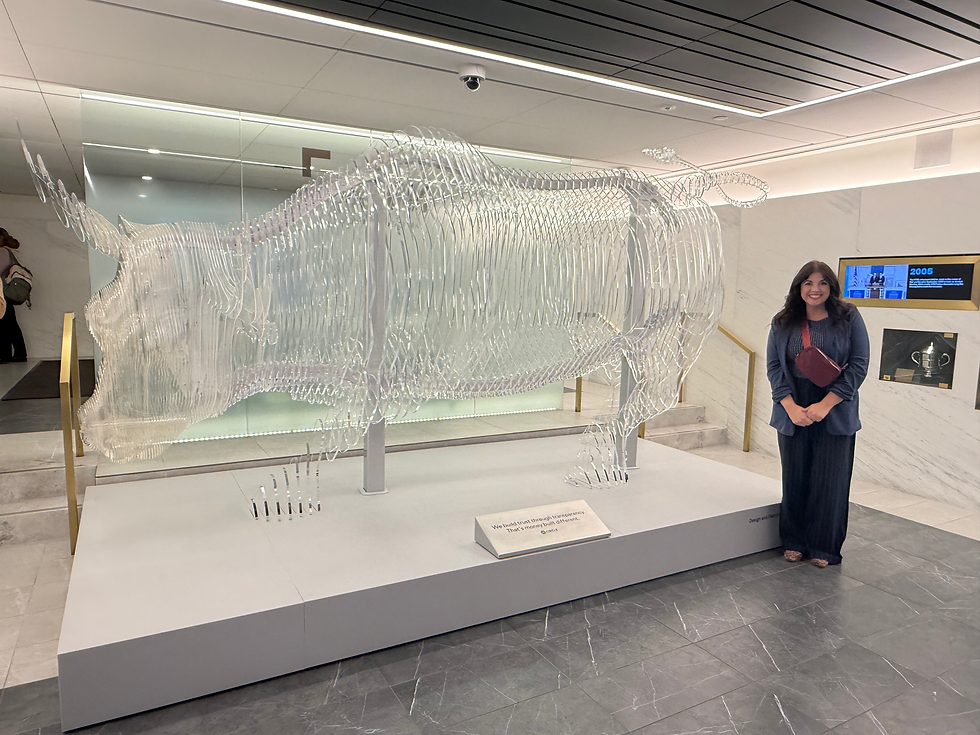
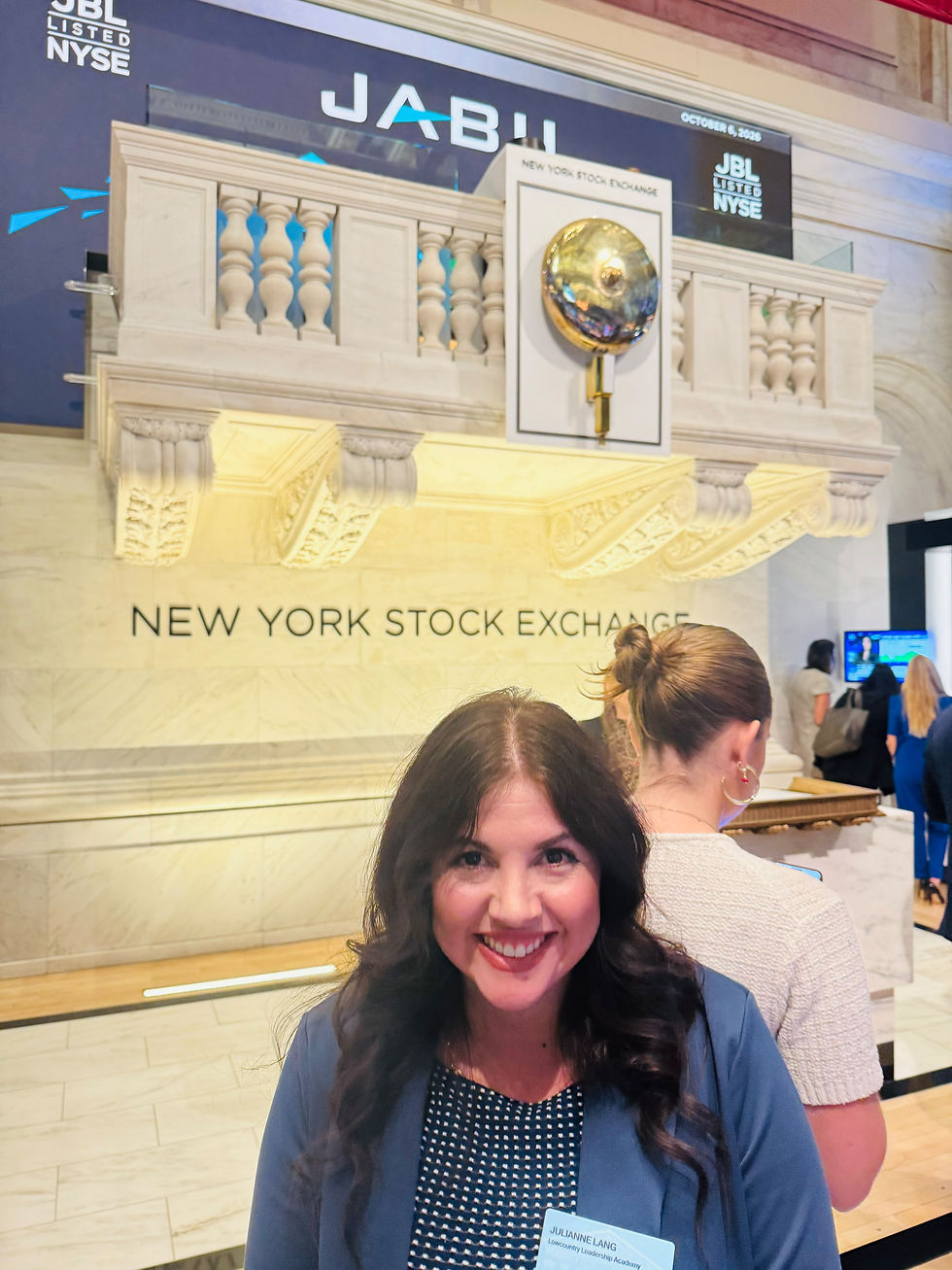
One of the most memorable experiences of our trip took us outside the classroom and onto the floor of the New York Stock Exchange for the closing bell!
Standing on that historic trading floor, surrounded by the energy of one of the world's most recognizable financial institutions, was an experience I won't soon forget. But what made the visit particularly meaningful was the robust history lesson that accompanied it.
Learning about the Stock Exchange's origins, the evolution of financial markets, and the structures that have shaped American business gave me a deeper appreciation for the relationship between economic systems, organizational leadership, and long-term sustainability.
As someone who has spent most of my professional career in education, I have always understood the importance of responsible financial stewardship. However, stepping into my new role as CEO/Executive Director has challenged me to expand my understanding of organizational finance, business structures, and strategic growth.
The experience helped connect so many of those concepts in a tangible way. Whether leading a school, a corporation, or a nonprofit organization, sustainable success requires strong systems, financial responsibility, strategic decision-making, and a clear understanding of how every part of the organization works together.
And while I certainly don't plan to trade my school leadership responsibilities for a career on Wall Street, I walked away with a renewed appreciation for the business side of leadership.
Plus, how often do you get to say you spent an afternoon on the floor of the New York Stock Exchange for the closing bell?! Talk about a memorable professional learning experience!
Great Schools Don't Run on Good Intentions Alone
Another takeaway from our school visits had less to do with new programs and more to do with the systems that make great programs sustainable.
As leaders, we often celebrate innovation, creativity, and the extraordinary efforts of our people. And we should! But behind successful schools are intentional structures, clearly defined expectations, and procedures that create consistency.
One of the most valuable reminders from NYC was that excellence should not depend on who happens to be in the building that day.
Strong schools develop systems that allow their mission to come to life consistently.
At NYC iSchool, that means building structures that support personalization, advisory, and student-centered learning. At the Brooklyn STEAM Center, it means coordinating educational pathways, industry partnerships, and experiences that connect students from multiple schools to meaningful opportunities.
Different models. Different approaches. But a shared commitment to intentional design.
As I continue transitioning into my role as CEO/Executive Director at LLCS, this lesson feels especially relevant. Building a sustainable organization requires more than having the right people. It requires developing the right systems to support those people.
I returned with a renewed commitment to systematizing more of our procedures, strengthening organizational alignment, and creating structures that empower our leadership team to operate with clarity and confidence.
The goal isn't to create more paperwork or unnecessary processes. It's to create consistency, protect instructional time, and allow our educators to focus their energy where it belongs: on students. Great systems should make great teaching and leadership easier, not harder.
History, Hamilton, and a Little Broadway Magic
Of course, no trip to New York City would be complete without experiencing some of the incredible history and culture that make the city so special. And as a former history teacher and self-proclaimed musical theater nerd, this part of the trip was especially meaningful!
I had the opportunity to visit historic Trinity Church and see the grave of Alexander Hamilton, one of our nation's Founding Fathers and the first Secretary of the Treasury.
There was something surreal about standing in a place so deeply connected to the founding of our country, especially after spending time learning about the financial institutions that helped shape America's economic development.
History has always been one of my passions. As a former history teacher, I loved helping students understand that history isn't simply a collection of dates, events, and names in a textbook. It is the story of people, decisions, challenges, and ideas that continue to shape the world we live in today.
Standing at Hamilton's grave, just steps away from Wall Street, brought that history to life in an entirely different way.
And yes, for those who know me well, you better believe I made time for Broadway in the evenings after professional development while I was in the city!
Because what's a trip to New York without a little musical theater?
As someone who loves Hamilton, there was something especially meaningful about experiencing the places connected to the history that inspired such an extraordinary production. It was the perfect reminder of why authentic experiences matter so much in education.
There is a difference between learning about something and experiencing it firsthand.
It's the same philosophy we work to bring to life through project-based learning at LLCS. When students can connect what they learn in the classroom to the world around them, learning becomes more meaningful, memorable, and powerful.
And apparently, that philosophy still applies to former history teachers, too!
The Gift of Learning Alongside Other Leaders
Beyond the school visits, Wall Street, and historical experiences, one of the most meaningful parts of this trip was the opportunity to learn alongside other leaders.
There is something incredibly fulfilling about being surrounded by people who understand the weight of school leadership and still show up every day excited about what is possible.
We shared ideas, discussed challenges, celebrated innovation, and reflected on how our experiences could strengthen our own schools. I have always believed that leadership can be both challenging and deeply rewarding. Experiences like this remind me why I love this work so much.
Professional growth doesn't always happen behind a desk or inside a conference room. Sometimes it happens while walking through a school hallway, listening to a student explain their learning, standing on the floor of the New York Stock Exchange, or having a conversation with another leader who sees a familiar challenge through a completely different lens.
And sometimes, it happens in a New York minute.
Coming Home With More Than Inspiration
One of my personal expectations for professional development is that it should result in more than a collection of photographs and a notebook full of ideas.
Inspiration is wonderful. Implementation is where the impact happens.
For me, that means returning to my school with three clear priorities:
Expand dual enrollment opportunities in our CTE pathways so students can earn meaningful postsecondary credit and credentials.
Strengthen business and industry partnerships to provide more authentic career experiences, mentorship, and workforce connections.
Build stronger organizational systems and procedures that create consistency, accountability, and long-term sustainability.
These are not necessarily flashy initiatives, but they are the kinds of intentional improvements that can transform a school over time.
And that is the work I am excited to continue.
A Grateful Heart and a Full Cup
I want to extend my sincere gratitude to the Charter Institute at Erskine for continuing to invest in the professional growth of its school leaders.
Opportunities like this are more than professional development trips. They are investments in leadership capacity, stronger schools, and ultimately, the students and families we serve.
I am incredibly grateful for the relationships, experiences, and opportunities that have come through the School Leaders Cohort. Each experience continues to broaden my perspective and deepen my commitment to educational excellence.
As I reflect on our time in New York City, I find myself feeling something that I hope every leader experiences throughout their career: genuinely fulfilled by the work and excited about what comes next.
There is still so much to learn, so much to improve, and so much possibility ahead.
And what a privilege it is to be part of it. Here's to big ideas, bold leadership, a little NYC magic, and never losing the desire to learn.
Until next time, keep your coffee strong, your purpose clear, and your courage greater than your comfort zone.
With grace, grit, and a latte of gratitude,
Julianne
Leadership With a Latte






Comments